
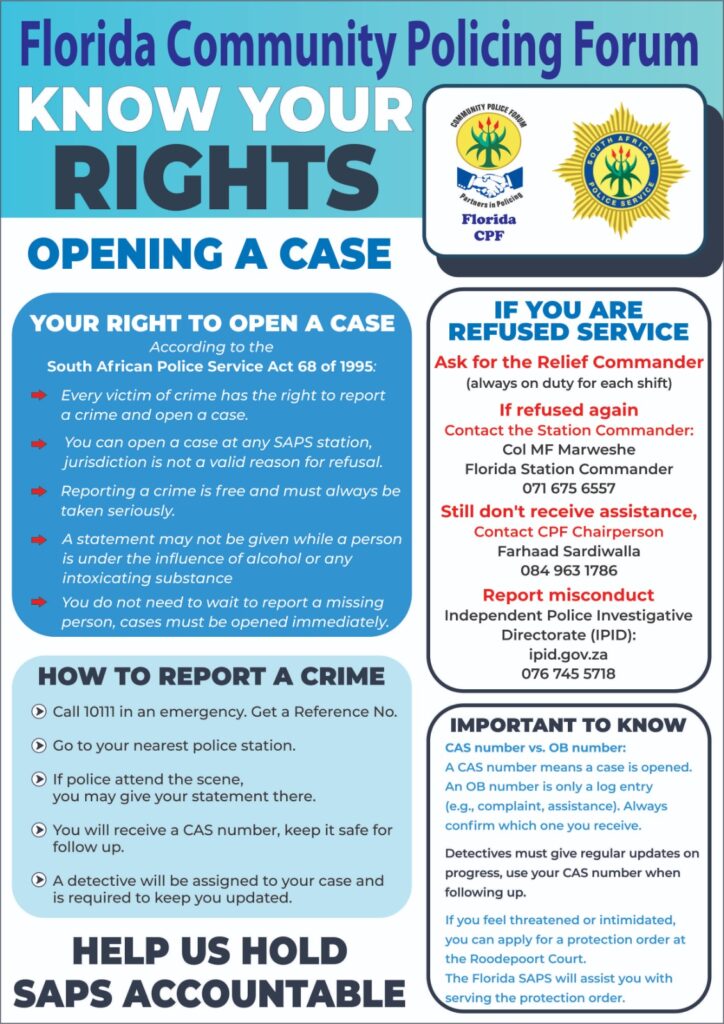
What to do if get turned away or denied assistance at SAPS Florida to open a case? According to the South African Police Service Act 68 of 1995:
✔ Every victim of crime has the right to report it and open a case.
✔ You may open a case at any SAPS station; jurisdiction is not a valid reason for refusal.
✔ Reporting a crime is free and must always be taken seriously.
✔ A statement may not be given while a person is under the influence of alcohol or any intoxicating substance.
✔ You do not need to wait to report a missing person, cases must be opened immediately.
- Service delivery complaints against SAPS and MPS members
The SAPS Service Complaint Centre to investigate poor service: Services | SAPS (South African Police Service)
IPID will not investigate service delivery complaints against SAPS or MPS members in instances such as failure to investigate, failure to assist, failure to give feedback, rudeness and police misconduct. These matters are now dealt with by the police inspectorate in the offices of SAPS Provincial Commissioners. Complaints Procedure | The Independent Police Investigative Directorate
Florida Community Policing Forum (CPF) has been established in terms of Chapter 7 of the South African Police Service Act, Act 68 of 1995 (the principal Act). The patrollers are in essence an independent sub-structure of the Florida Community Policing Forum.

The Logo comprises a handshake under the Aloe in a circle and surrounded by the words; ‘Community Police Forum’ and Partners in Policing’ on the top and bottom” respectively. The purpose of a CPF is to establish and maintain a safe and secure environment for its citizens. Organisations who want to make the community safe are welcome to join a CPF. A CPF is a structure that establishes a partnership between the community and the South African Police Service (SAPS). [Bylaw | Community Policing Forum (c-p-f.co.za)]
The significance (About Us | SAPS (South African Police Service)) of the green aloe with red flowers is:
- survivor which is able to operate effectively with very few resources
- found throughout South Africa irrespective of beautiful, cosy, harsh or dry surroundings
- able to deal with most conditions and are well equipped in terms of qualities and armoury
- have a healing effect on the community as a whole
- dynamic and change all the time, leaving their old, dry leaves behind at the bottom of the stem while creating better and stronger leaves higher up on the stem
- in spite of hard and bitter qualities, also possess qualities of beauty and care
- easily identified and are always eye-catching
- composition is extensive and they consist of many components
- form part of a larger ecosystem or community, on which dependent, therefore cannot exist and function on its own